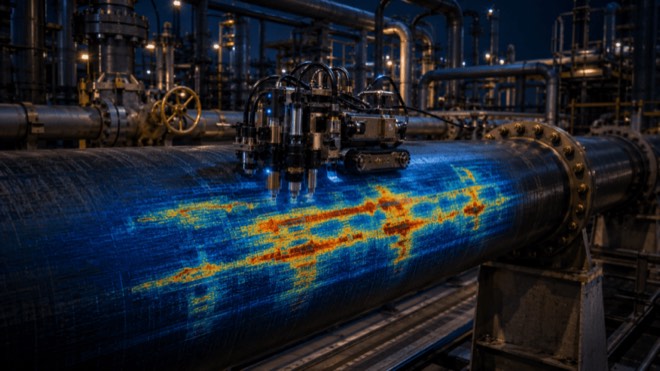
BVID Detection in Woven GFRP Laminates
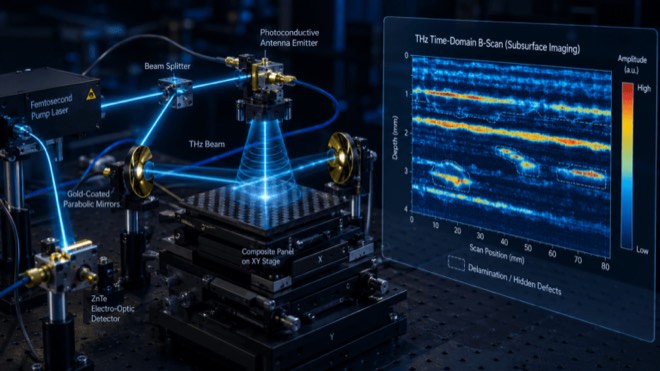
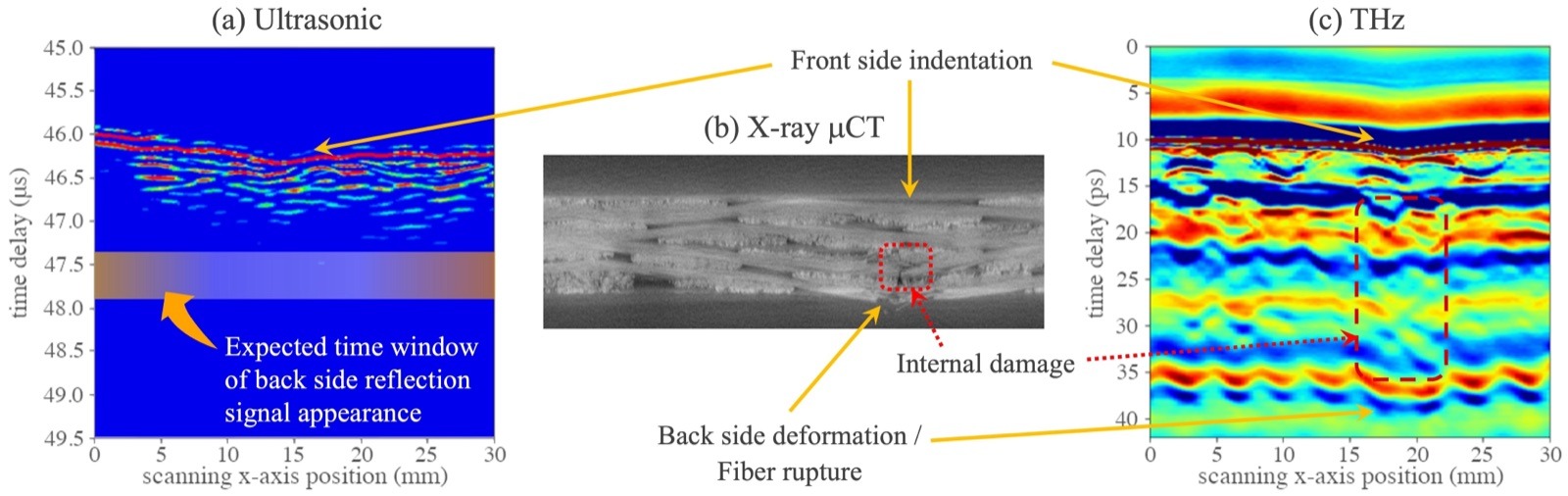
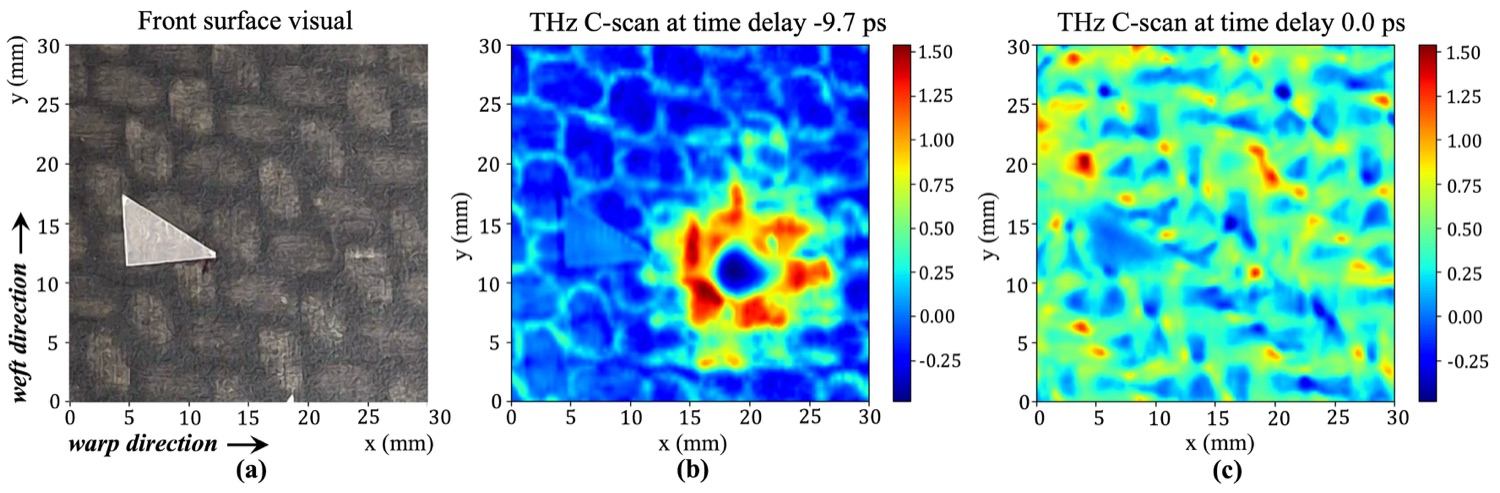
Transfer learning with a DenseNet-121 backbone classifies barely visible impact damage (BVID) in woven glass-fiber composite plates directly from terahertz time-of-flight B-scans. Ground truth is established by X-ray micro-computed tomography on a controlled low-velocity impact test bed, providing a reproducible benchmark for downstream localization and severity studies.
■DenseNet-121 accuracy = 99.1%
Status: publication link to be added
Physics-Guided Weakly Supervised Damage Localization
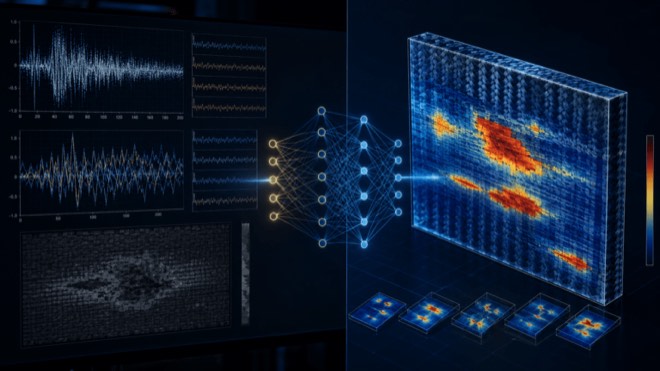
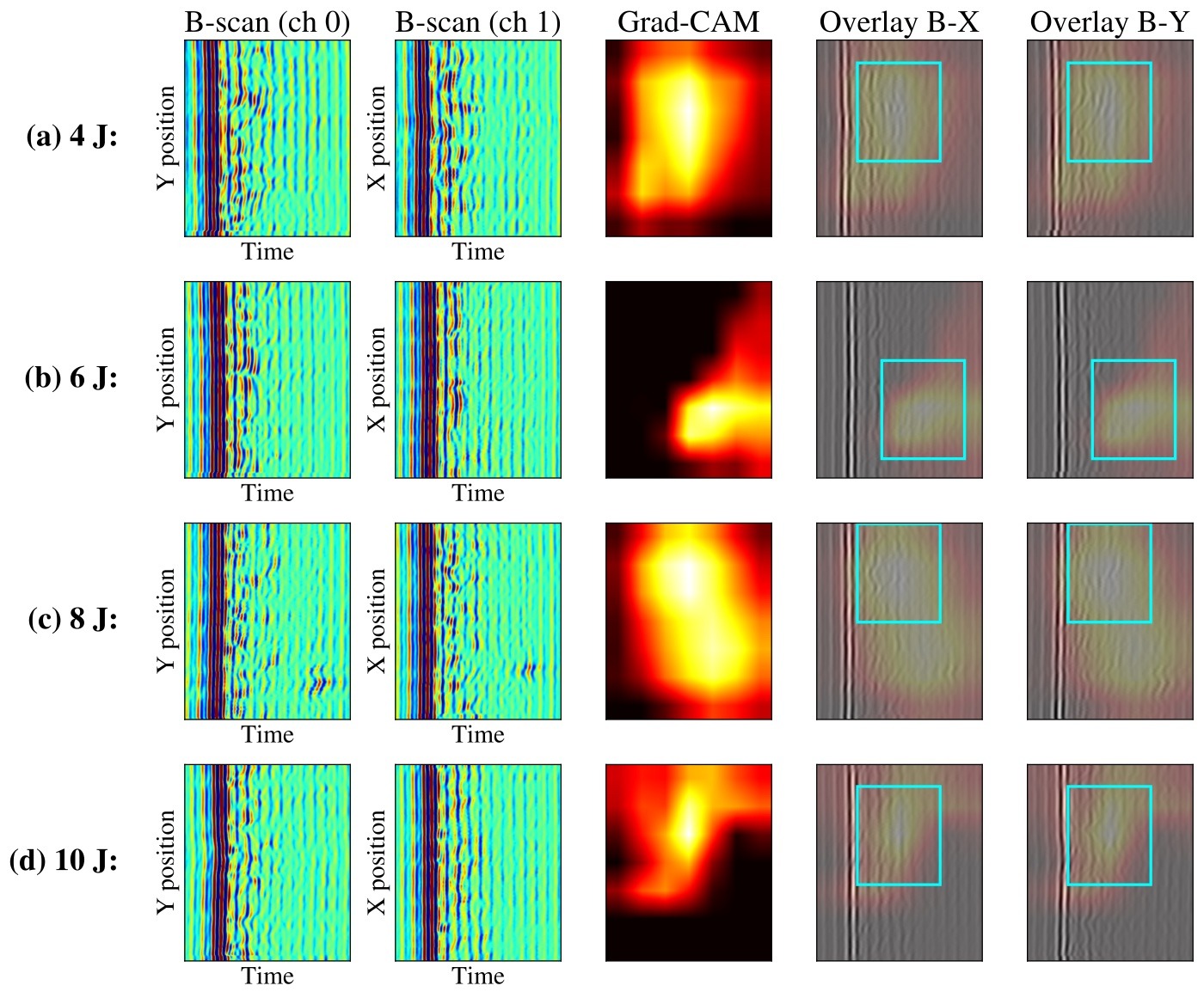
A modality-agnostic pipeline pretrains on synthetic data from coupled Abaqus/Explicit impact simulations and MEEP electromagnetic forward models. Gradient-based saliency is converted into pseudo-labels and a quantitative severity output, removing the need for pixel-level human annotation. The same network transfers without modification from terahertz to X-ray imagery of impacted GFRP laminates.
■Sim-to-real transfer · zero retraining
Status: OTST 2026 abstract submitted · manuscript in preparation
Multi-Task Subsurface Profilometry from FDTD-Synthetic THz
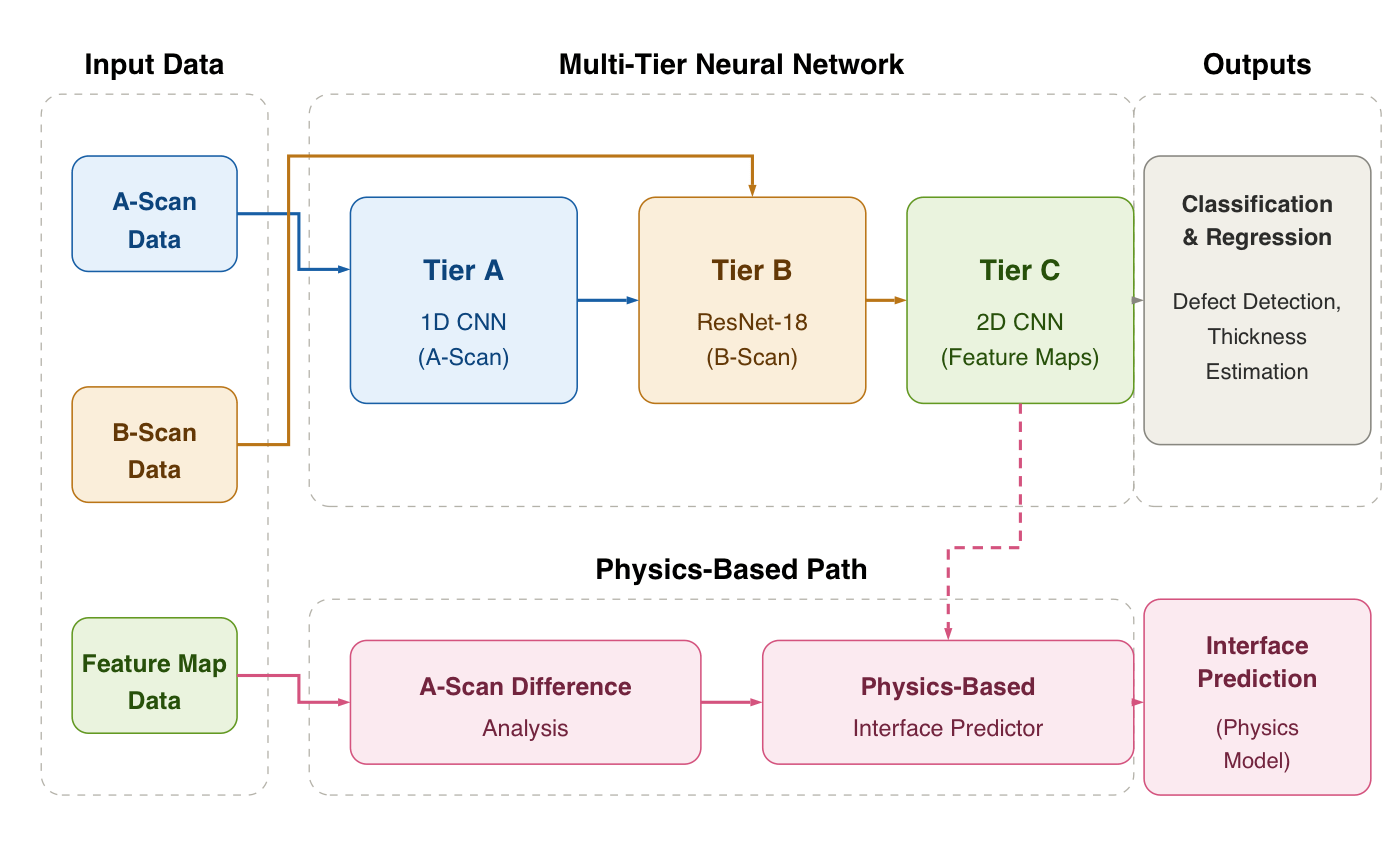
A three-tier multi-task network trained on one-dimensional FDTD simulations jointly predicts defect presence, interface index, ply count, defect thickness and diameter, and per-ply thicknesses with uncertainty-weighted losses. A calibrated physics-based predictor lifts interface localization accuracy from ≈14% to 91.6%, and the full pipeline transfers cleanly to an external GFRP benchmark.
■Interface accuracy 14% → 91.6%
Status: manuscript in preparation