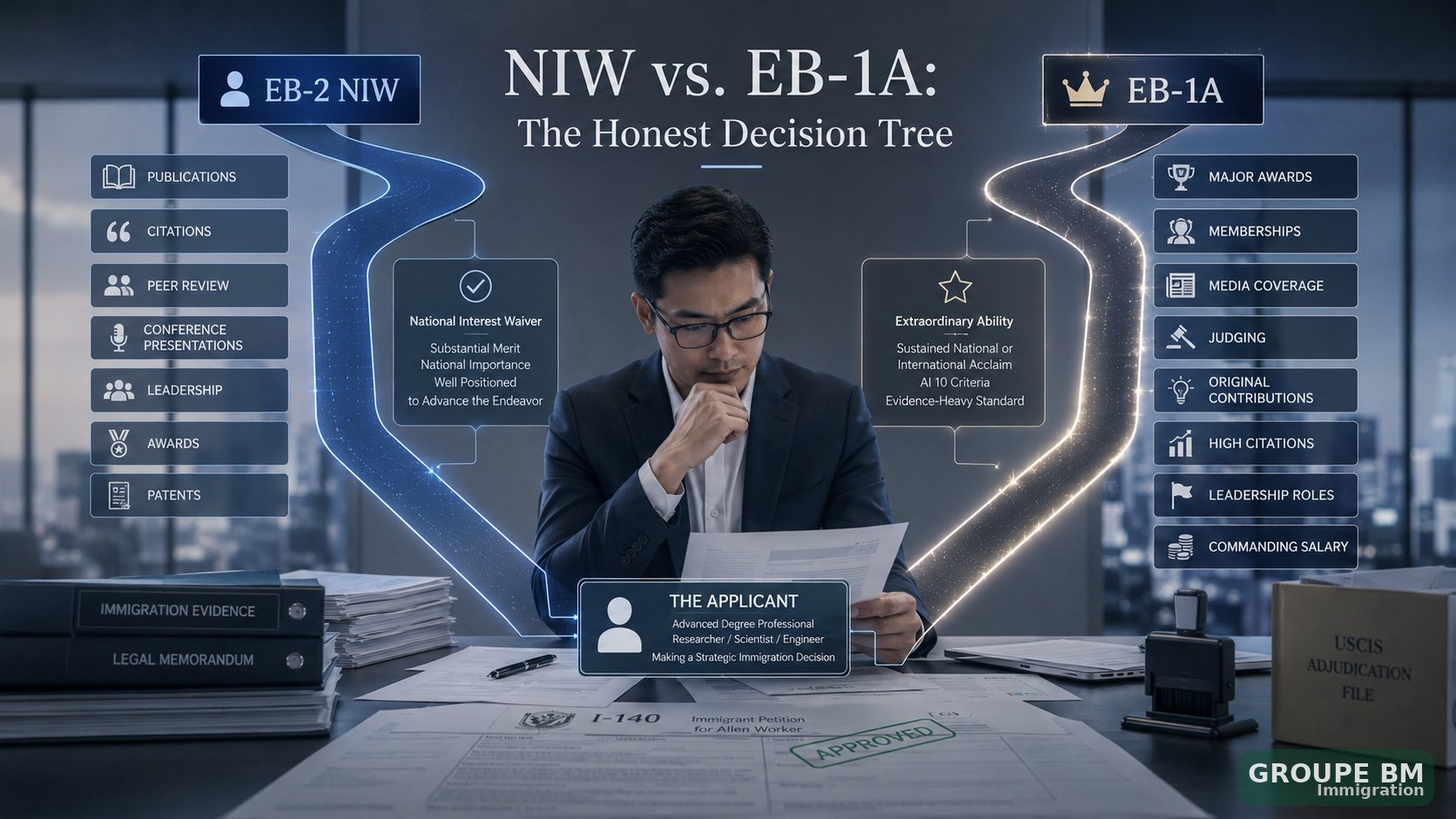
Most applicants choosing between an EB-2 National Interest Waiver and an EB-1A petition do not really need more inspiration. They need a candid second opinion. The volume of recycled “you qualify” content circulating across social media, immigration agency websites, and YouTube has distorted what these two categories actually look like when reviewed by a USCIS adjudicator. This article cuts through that noise.
What follows is the honest decision tree we use after twenty years of working alongside immigration counsel, including time spent on the other side of the desk reviewing employment-based immigrant petitions. The goal is simple: help you select the petition that fits your record, not the petition you wish your record fit.
Quick comparison: NIW vs. EB-1A

Both categories lead to U.S. permanent residence. Both bypass the labor certification requirement, which means no PERM and no employer sponsorship is required. From there, the similarities end.
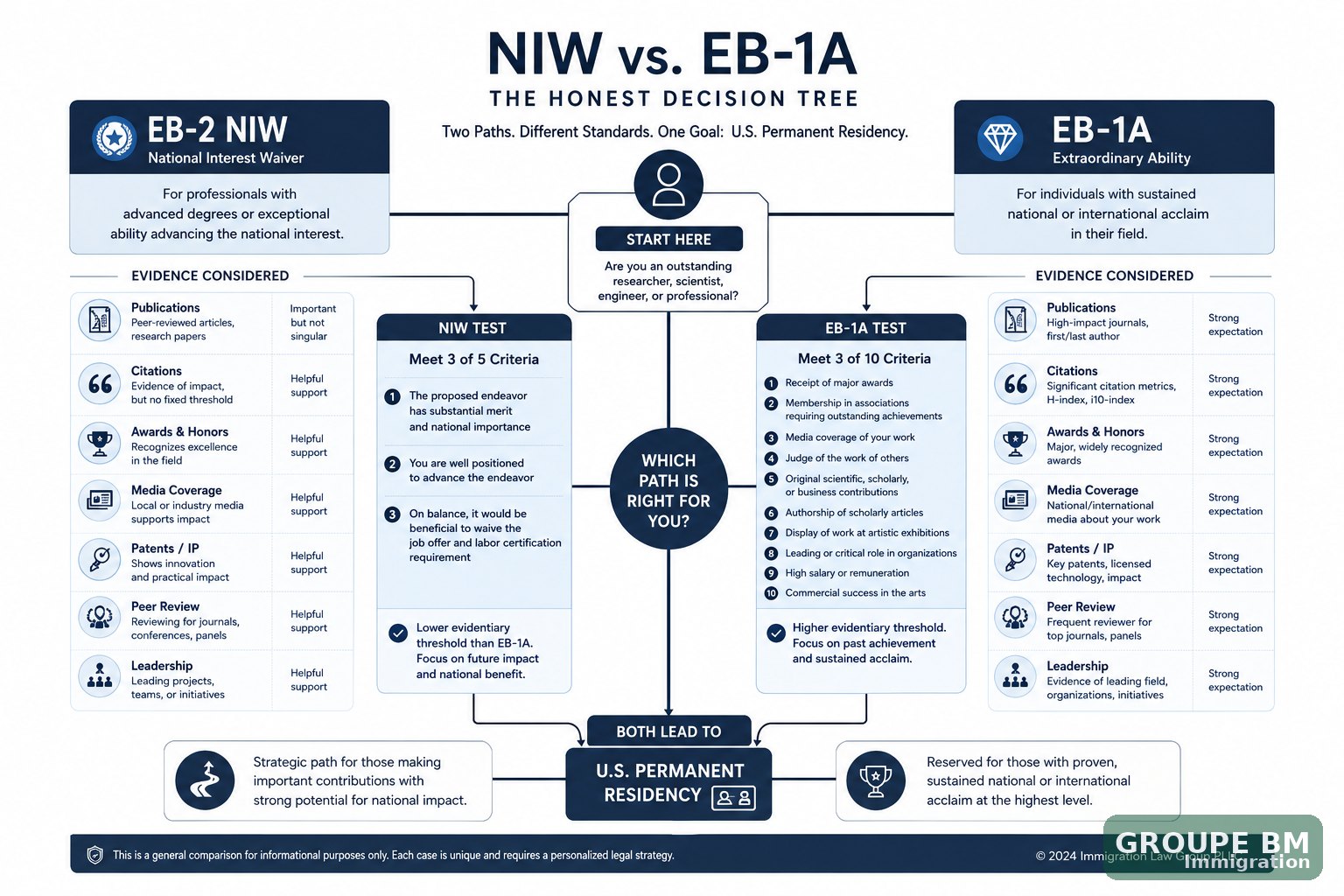
The EB-2 National Interest Waiver (NIW) asks whether your work has substantial merit and national importance, whether you are well positioned to advance it, and whether granting the waiver is in the national interest. It is governed by the 2016 Matter of Dhanasar framework. The bar is meaningful but reachable for many qualified professionals.
The EB-1A Extraordinary Ability category asks whether you have risen to the very top of your field and are part of that small percentage who has done so. The legal test is the 1990 statute, refined by the Kazarian two-step analysis. You must meet at least three of ten regulatory criteria and then satisfy a final merits determination that you have sustained national or international acclaim.
In practice, NIW is an evidence-of-impact case. EB-1A is an evidence-of-recognition case. That single distinction is where most premature filings fail.
The honest decision tree
Before measuring your evidence against either standard, answer these four questions honestly.
- Has your work been recognized externally, beyond your immediate employer or institution, in ways that other people in your field would acknowledge?
- Are you in a position to keep advancing this work in the United States, with concrete plans, audiences, or stakeholders?
- If you removed every record of your work from the internet, would peers in your field still know your name?
- Would you be comfortable explaining each criterion to a skeptical adjudicator using only your strongest evidence?
If your answers to questions 1 and 2 are yes but you hesitate on 3 and 4, NIW is the credible petition. If you answer all four with confidence and can document each, EB-1A becomes realistic. If you hesitate on 1 and 2, neither category is ready yet and the responsible answer is to build the record first.
Evidence markers that matter

USCIS officers do not count documents. They weigh evidence. The same exhibit can carry significant weight in one case and almost none in another, depending on context. Here is how the most common evidence types are actually evaluated.
Publications. Number alone is rarely persuasive. Officers look at the venue, your authorship position, the topical relevance to your stated field, and whether the work has influenced others. Twenty conference papers in a single proceedings carry less weight than five peer-reviewed articles in respected journals. First-author or sole-author placements carry more weight than middle-author appearances on large teams.
Citations. Citation counts are the single most misused metric in EB-1A filings. They establish that others have noticed your work, which is necessary but not sufficient. Officers consider citation density relative to your field, whether citations come from independent groups versus your own collaborators, and whether they reflect substantive engagement or routine acknowledgment. An h-index that looks impressive in one discipline is unremarkable in another. We do not assume a particular number guarantees approval, and neither should you.
Peer review activity. Reviewing for journals and conferences is one of the most reliable EB-1A criteria when documented properly. Invitations from editors, completed review records, and editorial board appointments all count. Reviewing one paper for one journal is not enough. A sustained pattern across multiple venues is what officers want to see.
Judging and reviewer experience. Serving on panels, jury committees, grant review boards, or thesis committees outside your own institution carries weight. Internal reviews of your own students do not. The judging must be of the work of others in your field.
Awards. Major prizes are highly persuasive. National or international awards, awards from independent professional associations, and competitive prizes with documented selection processes work. Internal employer recognitions, participation certificates, and self-nominated awards do little.
Media coverage. Coverage in major outlets about you and your work is one of the strongest EB-1A criteria. Trade publications and industry press can qualify if the outlet has independent editorial standards. Press releases, paid placements, podcast appearances, and articles you authored do not count as media coverage of you.
Memberships. Only memberships that require outstanding achievement as judged by recognized experts qualify. Membership in a society where dues are the only requirement adds nothing. Senior or fellow grades of major engineering and scientific societies, juried artistic memberships, and similarly selective bodies count.
Original contributions. This criterion is interpreted broadly but applied strictly. The contribution must be of major significance to the field, not merely original. Officers look for evidence of influence: adoption by others, integration into standards, references in textbooks, deployment at scale.
Patents. Granted patents demonstrate originality. Their weight depends on whether they have been licensed, commercialized, cited, or adopted. A pending application carries little weight. A granted patent that has been licensed to a major firm or cited in subsequent filings is meaningful.
Salary. High remuneration is a recognized criterion when documented with comparison data showing your salary is in the upper range for similarly situated professionals in your field and geography. BLS wage data, industry compensation surveys, and offer letters work. A six-figure salary in a region where six figures is typical does not qualify by itself.
Leadership roles. Distinguished roles for organizations with a strong reputation in the field qualify. The reputation of the organization matters. Critical roles at top firms, principal investigator status on major grants, founding scientist titles, and chair positions on standards committees are persuasive. A team lead title at a Series A startup is harder to defend.
Conference presentations. Invited keynotes and plenary talks at major conferences are strong EB-1A evidence. Standard contributed talks at conferences where anyone who submits is accepted are not. The distinction between invited and submitted matters more than applicants realize.
National or international recognition. This is not a separate criterion but the overall standard EB-1A must meet at the final merits step. Even when an applicant satisfies three of ten criteria, the officer steps back and asks whether the totality shows sustained acclaim at a national or international level. This is where many petitions fail despite meeting the numerical threshold.
When NIW is the better choice
NIW is the credible petition when your work has demonstrable merit and importance to the United States but your external recognition is still building. Strong NIW candidates typically include:
A postdoctoral researcher with a focused area of expertise, several peer-reviewed publications, a coherent research plan that connects to U.S. priorities (energy, biomedical, semiconductors, AI safety, water, agriculture, national security adjacent fields), and reasonable evidence of being well positioned to continue, including funded positions, collaborator letters, and a documented trajectory.
A mid-career engineer working on technology that addresses a national priority, with patents or deployments, internal company recognition, and clear evidence that the work serves U.S. interests beyond a single employer.
A physician practicing in a designated shortage area or in a specialty with documented national need, with credentials, publications or clinical contributions, and a service plan.
An entrepreneur whose venture addresses a substantial U.S. need, with traction metrics, customer evidence, regulatory engagement where relevant, and a path to scale.
What unites these profiles is that the work itself meets the NIW substantial-merit-and-national-importance test, and the applicant can credibly show they will keep advancing it in the United States. The petition tells a forward-looking story about impact.
When EB-1A is realistic

EB-1A becomes realistic when the record looks backward and the recognition is documented. A credible EB-1A applicant typically can show several of the following without strain:
- A pattern of independent citations from research groups around the world, not just collaborators, with citation density notably above typical for the field.
- Sustained peer review activity across multiple respected venues, including editorial board appointments or repeated invitations from journal editors.
- Awards or honors with documented competitive selection by recognized experts, ideally more than one.
- Media coverage by outlets with independent editorial standards, focused on the applicant or their work.
- Memberships in selective bodies that require outstanding achievement, with the selection criteria documented.
- Invited keynotes or plenary talks at major conferences with global reach.
- Original contributions that have been demonstrably adopted by others in the field, integrated into standards, or referenced in authoritative texts.
- A salary in the upper range for similarly situated professionals, supported by comparison data.
When three or more of these are present with strong documentation, and when the totality of the record reads like sustained acclaim, EB-1A is the right petition. Notice that this is a high bar deliberately. The category exists for the small percentage at the top.
When EB-1A is premature
EB-1A is premature when the record shows promise but not yet sustained acclaim. Common premature profiles include:
A recent PhD with several publications, a respectable but field-typical citation count, no media coverage, no awards beyond internal recognition, and no documented judging activity. The future may hold EB-1A, but the present case relies on speculation.
A successful industry professional with internal awards, a strong salary justified by region and seniority, and team accomplishments. The accomplishments are real but the external recognition is limited.
A researcher with high citations driven primarily by a single high-profile paper or by self-citations and collaborator citations. The numbers look strong on the surface but do not survive scrutiny.
An entrepreneur whose company has received press but where the coverage is about the company rather than the individual, and where most achievements are still forward looking.
In each case, the responsible recommendation is often NIW now and EB-1A later, not EB-1A as a stretch.
When to file NIW first and EB-1A later
For many applicants, filing NIW first is the strategically correct move even when EB-1A might eventually become viable. Reasons:
The NIW approval provides priority date protection. If priority dates retrogress, the earlier filing date matters.
NIW is self-petitioned just like EB-1A. There is no employer dependency for either category, so filing one does not foreclose the other.
A subsequent EB-1A filing benefits from the additional time to build the record: more citations accrue, more peer review activity accumulates, more awards may be earned, more media coverage may occur.
Filing two petitions in parallel or sequentially is permitted. There is no rule against having both an NIW and an EB-1A on file. The cost is filing fees and attorney time, which can be reasonable insurance for applicants with uncertain timelines.
The decision is not always NIW first. For applicants whose EB-1A case is already strong and who do not face retrogression concerns, filing EB-1A directly may be more efficient. The choice is case specific.
Special considerations by applicant profile

PhD students should generally wait. A PhD candidate without the degree in hand and without publications outside their advisor’s lab will struggle in either category. The exception is exceptional cases where the student has independent recognition, but these are rare. The honest recommendation for most PhD students is to graduate first, complete a postdoc or industry role, and revisit.
Postdoctoral researchers are often strong NIW candidates and occasionally EB-1A candidates near the end of long postdocs. The key markers are publication record, citation pattern, peer review activity, and forward trajectory.
Engineers in industry often have strong NIW profiles built around national-priority technologies, especially in semiconductors, energy, defense adjacent fields, and advanced manufacturing. EB-1A becomes realistic for senior principal engineers, fellows, and technical leaders with patents that have been licensed or widely cited, and with industry awards or invited talks.
Entrepreneurs face a category mismatch problem. NIW often fits well when the venture serves U.S. interests. EB-1A fits when the entrepreneur personally has received recognition that meets the standard. Press about the company is not the same as press about the founder.
Physicians have several pathways. NIW is well established for physicians practicing in shortage areas or pursuing research with national importance. EB-1A is realistic for physicians with substantial research records, leadership positions, and sustained external recognition.
Industry professionals outside engineering should evaluate honestly whether their external recognition exists outside their employer. A vice president at a respected firm with industry awards, board appointments, and a publication or speaking record is in a different position from a vice president whose accomplishments are mostly internal.
Academics at the assistant professor level rarely have EB-1A cases unless they have built recognition during postdoc or industry work first. Tenured faculty with sustained recognition often do. Mid-career faculty with strong but field-typical records often fit NIW better than EB-1A.
Common myths and hard truths
Myth: A specific citation count guarantees EB-1A approval. No threshold guarantees approval. Officers evaluate citations in context: field norms, independence, density, and what the citations actually engage with. We have seen approvals at lower counts and denials at higher counts. The number is one input among many.
Myth: Filing more exhibits strengthens the case. Volume without focus often weakens cases. Officers do not have unlimited time. A petition that buries strong evidence inside hundreds of weak exhibits invites doubt. Curate ruthlessly.
Myth: Internal awards and certificates from your employer count. They generally do not. Officers look for recognition from outside the employer, judged by experts in the field.
Myth: Press releases and self-authored articles count as media coverage. They do not. Media coverage means independent journalists writing about you in outlets with editorial standards.
Myth: Membership in any professional society counts. Only memberships requiring outstanding achievement as judged by recognized experts qualify. Most professional society memberships are dues based and do not qualify.
Myth: An NIW approval guarantees an EB-1A approval later. The categories are independent. An approved NIW does not predict an EB-1A outcome. The standards are different and the evidence focus is different.
Hard truth: Adjudication trends shift. Officer scrutiny ebbs and flows. The same case that would have approved smoothly in one period may face requests for evidence in another. Build the record so it can survive a stricter review, not just a permissive one.
Hard truth: Letters are not magic. Expert recommendation letters help, but they cannot substitute for documented external recognition. A petition built primarily on letters with thin underlying evidence rarely succeeds.
Hard truth: Marketing claims are not legal opinions. When an agency tells you that you are EB-1A ready before reviewing your CV in depth, treat that with skepticism. A genuine assessment takes hours, not minutes, and produces specific feedback about each criterion.
Final recommendation
Choose the petition your record actually supports today. If your work is meritorious and important and you can show you are well positioned to advance it, NIW is the credible path. If your record shows sustained external recognition documented across multiple criteria, EB-1A is realistic. If your record is in between, file NIW now, build the record, and revisit EB-1A in twelve to twenty-four months.
The applicants who succeed in these categories are the ones who picked the right petition for who they are now, not who they hope to become. Honesty up front saves time, money, and the stress of an avoidable denial.
If you would like a candid review of your profile against both standards, our team at Groupe BM is available for a free consultation. We will tell you which category fits your record, what is missing, and what a realistic timeline looks like.
Disclaimer
This article is for educational purposes only and does not constitute legal advice. Immigration outcomes depend on individual facts, evidence quality, current adjudication trends, and other factors that are not addressed in a general article. Please consult a qualified U.S. immigration attorney for case-specific guidance before filing any petition.